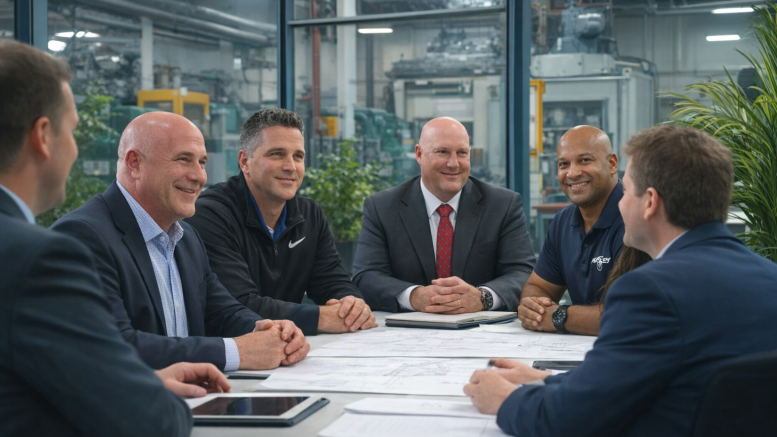
The OpExChange held a phenomenal event this week — and it was a little different than what we’ve done in the past. This was our first-ever “Plant Manager Exchange,” a pilot format built specifically for plant leaders to collaborate in a safe, peer-to-peer environment and trade ideas on the challenges that exist in every operation.
The idea originated from Dale McClelland (Plant Manager, Timken – Tyger River | OpExChange Board Member) who shared something that resonated with a lot of us:
“Whenever I go to an OpExChange plant visit, I’m always scanning the room to see who the other plant managers are — I love to talk with them and benchmark with them.”
Dale proposed creating a dedicated forum where plant managers could connect directly, compare notes, and learn from one another.
Another longtime OpExChange member and current board member, Scott Greene, reinforced a theme we’ve seen for years: while plant tours and workshops are incredibly valuable, the real “gold” of OpExChange is the network and relationships that are forged – the kind that lead to benchmarking calls, shared best practices, and help between events. Dale and Scott both have roots going back to the early origins of OpExChange when it launched through SCMEP in 2002, and this session felt like a return to that original mission: manufacturers helping manufacturers.
This session was hosted at the Heidelberg Materials training facility in Lexington, generously offered by Paul Kabis (OpExChange Board Member). And what stood out immediately was the industry diversity in the room – plant leaders representing aerospace and defense, medical and life sciences, automotive suppliers, industrial textiles, firearms, power systems, building materials, precision machining, and metal fabrication. That mix creates a powerful dynamic: when leaders from different sectors share what’s working (and what’s not), the conversation rises above industry silos and focuses on what truly drives performance – people, process, and technology.
Prior to the meeting, the group voted on topics ahead of time and then dug into four breakout-table discussions:
- Communication Best Practices
- Critical KPIs
- Employee Turnover
- Kaizen / Continuous Improvement Success Stories
The engagement was off the charts. In fact, Dale joked it was often hard to rotate tables or break for lunch because the conversations were so deep and practical. Several participants said the same thing: this felt like a safe place – not a “boasting” session – but a room where people could ask real questions and learn how others navigate similar challenges.
In typical OpExChange fashion, the session wrapped up with a Plus/Delta discussion to capture what worked well and how we can improve the next one. The message was consistent: everyone wants another session, likely in about three months, with narrower topics so they can go “one mile wide and ten miles deep.”
One of the best signs of success was what happened after the meeting: the group immediately started talking about how to keep the momentum going between sessions – turning this from a one-time event into an ongoing peer forum. Options are being explored to set up a private, invitation-only space for this group to stay connected and continue sharing best practices. There were also some side-bar discussions about B2B relationships.
And the impact may extend beyond plant managers. At the end of the meeting, Todd Jamison (HR Leader, Phoenix Specialty | OpExChange Board Member) offered to facilitate a similar Exchange for HR leaders – another job-specific peer group that could deliver huge value across the network.
This event reminded us why OpExChange exists: not just to host great events, but to build relationships that create lasting value long after the meeting ends. More to come – and if you were in the room, thank you for showing up, sharing openly, and making this pilot a success!
Additional Nuggets from the ExChange
Each of the four table moderators (Shane Goings, Jeff Drake, Rhett Carpenter, and Kirsten Gallagher) provided summaries from the discussion tables and the Plus/Delta section. These nuggets are compilations of their summaries.
🗣 Communication Best Practices – Leadership is Personal
Communication was framed not as a program, but as a daily leadership discipline.
- Explain the “Why.” Associates want to understand the reasoning behind decisions.
- Be transparent and follow through. Credibility is built through consistency.
- Daily huddles tied to KPIs and monthly “state of the business” updates improve alignment around safety, profit, and performance.
- Standardize expectations. Write them down. Be specific. Avoid assumptions.
- Prioritize 1-on-1 conversations. Weekly check-ins reinforce clarity and trust.
- Practice visible leadership. Gemba walks, open-door access, and regular floor interaction matter.
- Encourage two-way dialogue. Pulse surveys and expectation-setting meetings ensure people feel heard.
- Focus on wins as well as gaps.
- Blame the process, not the person.
- Above all: People don’t care how much you know until they know how much you care.
📊 KPI Discussion – Morale as a Strategic Lever
Morale and engagement were the most discussed KPIs — and the hardest to measure.
- Treat morale as a strategic driver, not a “soft” metric.
- Link engagement directly to safety, quality, and productivity outcomes.
- Consider an hourly-only morale committee with rotating representation and a modest budget.
- Use visible idea boards to track suggestions and status.
- Deploy short, frequent pulse surveys followed by action.
- Coach and empower informal floor leaders.
- Reinforce psychological safety and consistent follow-through.
Key question: How do we measure morale in a way that drives action — not just awareness?
🔁 Turnover – Strong Results, Clear Focus Areas
Reported turnover among attendees averaged ~10%, (low of 2%, high of 20%) significantly below regional benchmarks (24–38%).
Top drivers:
- Attendance
- Pay competitiveness
- Demanding schedules
- Limited growth opportunities
- Retirement planning gaps
Best practices shared:
- Visible career progression plans
- 30/60/90-day onboarding check-ins and mentoring
- Regular pay benchmarking studies
- Flexible scheduling (4x10s, early Fridays, blackout bonuses)
- Profit-sharing to increase buy-in
- Structured retirement transition planning with knowledge transfer incentives
- Transparent financial and KPI communication
A looming reality: up to 30% of today’s workforce may retire by 2030 — succession planning must accelerate.
⚙️ Kaizen & Continuous Improvement – Execution Wins
Kaizen events succeed when they focus on implementation – not planning.
- One team saved 110,000 gallons of fuel in 2025, improved productivity by 8%, and rewarded contributors.
- Empower operators to experiment and test ideas.
- Use data against a clear baseline.
- Maintain urgency and clear deadlines.
- Integrate maintenance early to accelerate small wins.
- Tie improvement efforts to recognition and meaningful rewards.
Ongoing tension:
Balancing production demands with time for improvement – but as one leader said, “We can’t afford not to improve.”
➕ / ➖ Plus–Delta Feedback on the Event
Strengths
- Safe, non-competitive environment
- Strong industry and experience diversity
- Topic voting in advance
- Rotating breakout format
- High-value networking
Opportunities
- More time per breakout
- Narrower topics for deeper dives
- Better room separation
- Pre-collected questions to sharpen discussion
Future Ideas
- Quality Management Systems
- AI in operations
- HR-focused exchange
- KPI deep dives
- Semi-annual gatherings
- Mentoring program to prepare next-generation leaders
Final Takeaway
Plant managers don’t need more theory – they need trusted peers they can call when challenges arise.
This pilot proved there is strong appetite for structured, job-specific peer collaboration. The momentum is building – and the question in the room was clear: “When’s the next one?”
About OpExChange
The OpExChange, sponsored by the South Carolina Manufacturing Extension Partnership, is a peer-to-peer network of manufacturers and distributors in South Carolina known for generating success for members through benchmarking and best practice sharing. Member companies host events and share practical examples of industrial automation, lean manufacturing improvements, and leadership development. It is an invaluable resource to South Carolina companies that provide access to others who are on similar improvement journeys. If your company is interested in participating in this collaborative effort to improve both the competitiveness of your operation and South Carolina, contact Mike Demos (MDemos@scmep.org). More information and upcoming plant visits are available on the OpExChange website www.OpExChange.com.
Be the first to comment on "The Plant Manager Exchange – OpExChange Pilot"