


By Mike Demos, OpExChange Coordinator for the SCMEP
Summerville, SC – The manufacturing landscape is in constant flux, and nowhere is this more evident than in today’s automotive industry. Electrification, digitalization, shifting supply chains, workforce challenges, and sustainability mandates are forcing manufacturers to adapt at an unprecedented pace.
Amid this dynamic environment, IFA’s Charleston plant in Summerville stands out as a company proactively embracing change. The tier-one automotive supplier is making substantial investments to overhaul both its product lines and manufacturing processes – and offering a model for others in the process.
On June 26th, IFA hosted a site visit for the OpExChange, South Carolina’s manufacturing peer network. Active members for over eleven years, IFA welcomed industry peers for an in-depth tour and benchmarking event, showcasing their forward-looking approach to navigating the automotive sector’s evolving demands.
A Global Player with Local Impact
Christian Knips, Operations Manager for the Charleston site, led the tour alongside Dr. Huri Mendoza, the site’s Engineering Manager. Knips, who has been with IFA since 2013 with experience in Germany and Poland, has been at the Summerville facility for nearly five years.
IFA is a global operation, headquartered in Haldenleben, Germany, with 2,200 employees worldwide and 2024 revenues of approximately $760 million. Along with their plants in Poland and Shanghai, the Charleston operation plays a critical role in serving OEM clients like Mercedes, BMW, Stellantis, and Ford.
Historically known for its prop shafts, particularly for internal combustion vehicles, IFA is now strategically diversifying its portfolio. The company began machining its own joints in 2019 and is now expanding into half shafts –components vital for both traditional and battery electric vehicles.
$40 Million Investment in Automation and Capacity
The Summerville plant, spanning 450,000 square feet and employing about 540 people, is in the midst of a significant $40 million capital investment. This includes the integration of:
- Two new automated machining lines
- Three new assembly lines for joints
- Three additional half-shaft lines
These expansions directly support new programs with BMW, Stellantis, and Ford’s Maverick and Bronco (CE1) lines, which include partially electric drivetrains.
A centerpiece of this transformation is the world’s first fully automated half-shaft assembly line, with two additional lines slated for completion this year. These modern, highly efficient lines occupy just one-third the floor space and require one-third the personnel while delivering 150% of the output compared to older lines – a clear leap in productivity.
A Glimpse into the Plant Transformation
The OpExChange tour offered members a comprehensive look at how IFA is evolving — from traditional operations to cutting-edge automation.
Assembly Area: A Leap Towards Automation
The tour began with the plant’s traditional, manual, batch-process assembly lines. All shaft production follows a three-step sequence: friction welding, assembly, and balancing. Friction welding, which uses heat generated by friction rather than a traditional arc, delivers significant advantages in both speed and weld integrity.
Attendees first observed the conventional assembly lines (Lines 5 and 8) before moving to the standout automated half-shaft assembly line (Line 11).
This fully automated line embodies IFA’s focus on efficiency and traceability. Components – including the shaft, axle stub wheel, axle stub gearbox, rubber boots, and clamps – are delivered by conveyors, with robots performing the assembly. Impressively, this is the first IFA line to achieve 100% traceability.
Key automated stations manage joint greasing, clip and rubber boot application, and joint pressing. A particularly notable advancement is the automated closing of boot clamps, a task that was once performed manually.
One highlight is a 3D scanner that captures the entire shaft circumference, creating a digital model. This guides the servo for precise clamp placement and instantly detects any mispositioned boots – a level of process control that even impressed BMW, one of IFA’s key clients.
The efficiency gains are significant: the automated line produces up to 700 shafts per shift with just two operators. In contrast, earlier lines required six people across three shifts to produce 1,000 shafts.
Problem Solving: Simple, Visual, and Immediate
Beyond physical automation, IFA is equally committed to refining how it manages daily operations and problem resolution.
Dr. Mendoza detailed the plant’s visual problem-solving system, centered around a whiteboard listing the top three problems, corrective actions, a “due time” (emphasizing immediacy over a due date), and assigned responsibilities. As he noted, “When I ask when it will be done, I’m checking my watch, not the calendar.”
This system is reinforced by three daily cascade meetings:
- Beginning of shift: Supervisors, teams, and support groups
- 9:00 a.m.: All group leads
- 11:30 a.m.: Plant managers
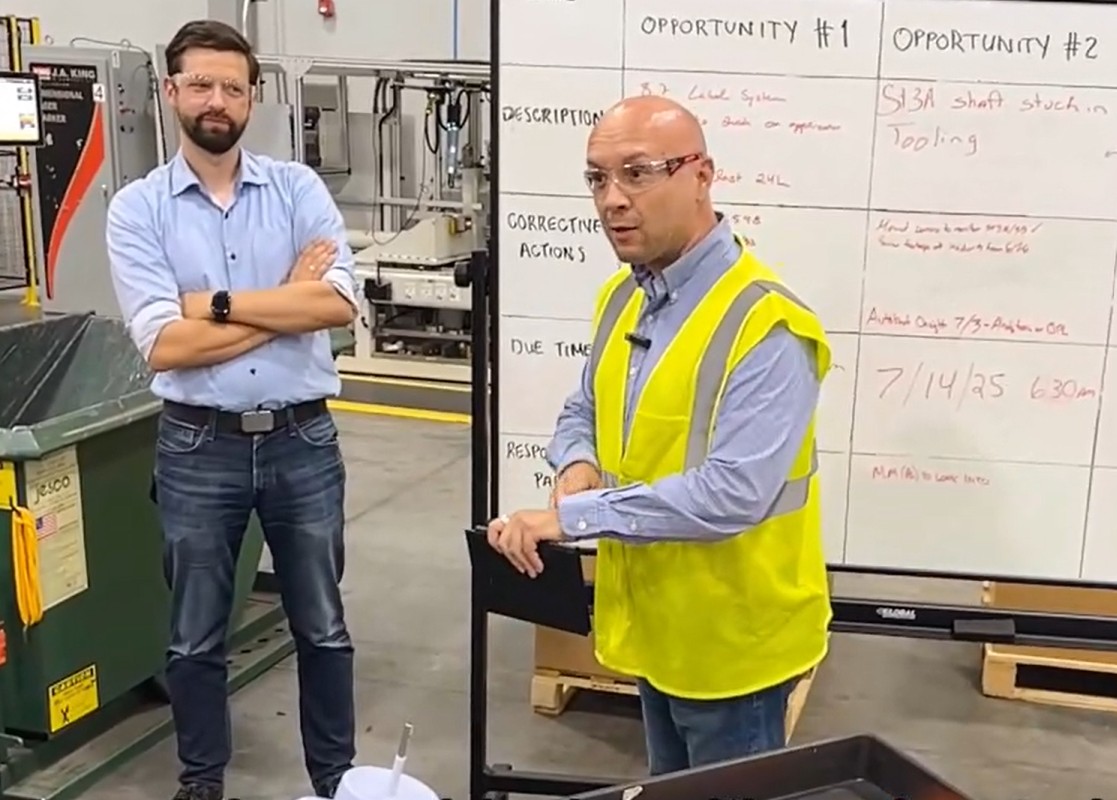
A distinctive feature is the use of cascade tickets – the original stays posted, while a carbon copy is handed to the responsible party, ensuring visible accountability. The plant tracks not just problems but the number of issues resolved daily – keeping the focus on action.
Machining Area: Embracing Robotics for Continuous Flow
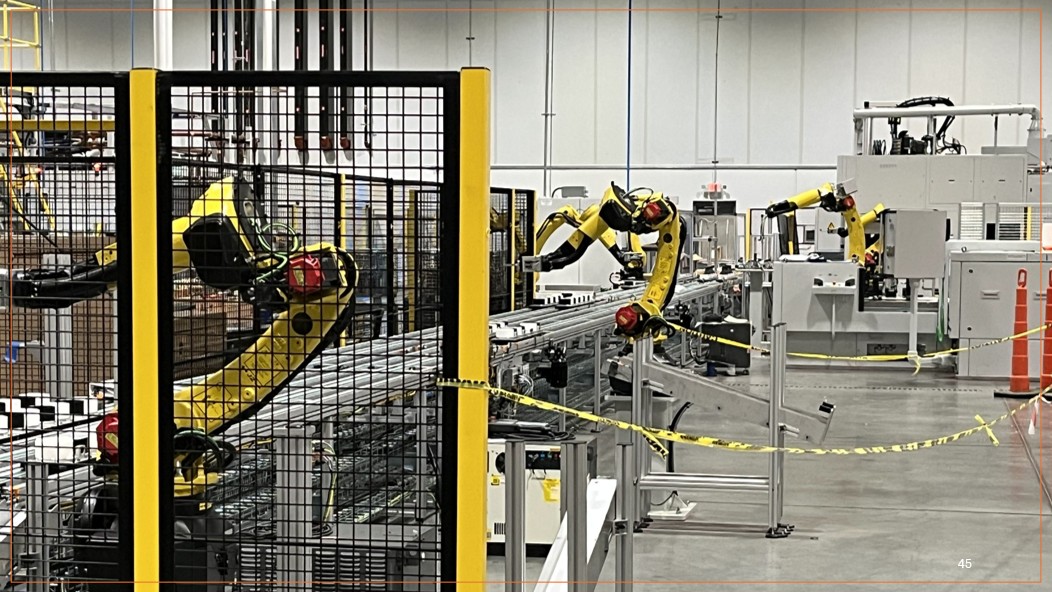
In the machining area, IFA currently operates three traditional lines with EMAG equipment, handling processes like soft milling, rough shaping, stack down, and hard milling of forged parts. While partially automated, these lines rely on batch operations and manual part handling.
A major shift is underway as two fully automated machining lines are being integrated. These lines – also equipped with EMAG machines – each feature eleven Fanuc robots, achieving continuous flow by fully automating loading and unloading.
Additionally, a semi-automatic machining line for core joints is being commissioned.
A smart example of Poka-Yoke (mistake-proofing) was demonstrated: operators must scan the correct bearing barcode before a hopper will open to accept parts. This simple safeguard prevents costly errors before they happen.
Cultivating the Future Workforce
During the tour, Dr. Mendoza proudly introduced a group of local university interns working on the new automated lines. These students aren’t just observing – they’re actively involved in system implementation and documentation development.
Dr. Mendoza emphasized that while automation reduces manual roles, it simultaneously increases the need for highly skilled technical positions. These interns represent the next generation of engineers ready to support the plant’s evolution.
A Roadmap for Manufacturing Future
From advanced robotics and continuous flow machining to visual management systems and workforce development, IFA Summerville is methodically reinventing both what it makes and how it makes it.
The OpExChange visit provided a valuable glimpse into how a forward-thinking manufacturer can stay competitive in a rapidly shifting industry. Through bold capital investments, vertical integration, and disciplined operational practices, IFA isn’t just adapting – it’s setting the standard for what modern automotive manufacturing can be.
For OpExChange members and the broader manufacturing community, IFA offers a compelling reminder: with the right strategy, culture, and mindset, transformation is not only achievable
