

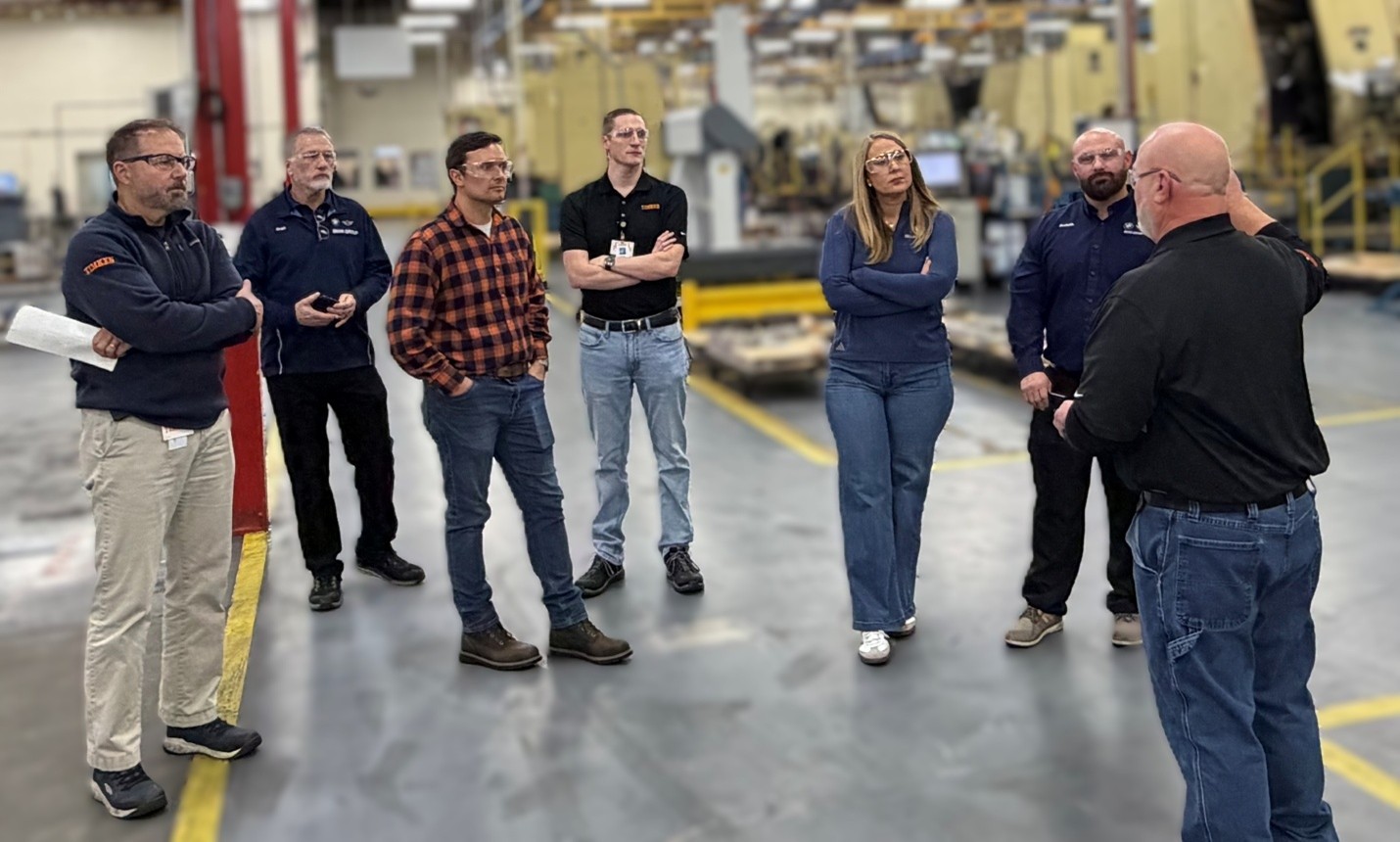
On January 13, members of the OpExChange gathered at Timken’s Tyger River plant for a deep dive into the next evolution of the Timken Manufacturing Operating System (TMOS 2). More than a traditional plant tour, the visit offered an inside look at how a 125‑year‑old company continues to evolve – combining disciplined systems, advanced data connectivity, and a workforce with extraordinary tenure to deliver short lead times in a highly complex job shop environment.
The visit was hosted by Dale McClelland, Plant Manager, with key contributions from Joey Mayes, Timken’s North American Lean and EHS leadership, Przemek Wlodarczyk, Supply Chain Manager, and members of Dale’s leadership team. Presentations were followed by a structured shop-floor tour and concluded with a collaborative plus/delta feedback session.
Timken: A Legacy of Engineering Excellence
Founded in 1899 by Henry Timken, the Timken Company has grown from its origins in tapered roller bearings into a global leader in engineered bearings and industrial motion. Today, Timken is a publicly traded company with nearly $5 billion in annual revenue, operations in dozens of countries, and a portfolio that extends well beyond bearings into power transmission, gears, drives, belts, chains, lubrication systems, and linear motion.
While the Timken name is synonymous with bearings, the company’s defining characteristic is its relentless focus on engineering solutions for demanding applications. From steel mills and wind energy to mining, military, and heavy equipment, Timken products operate in environments where failure is not an option. That expectation for reliability is deeply embedded in how Timken designs, manufactures, and continuously improves its operations.
During the visit, Dale McClelland was direct about what ultimately drives the company’s standards on the manufacturing floor:
“Timken is by far the best bearings that you can buy,” Dale said. “Our bearings typically last twice as long as our competitors.”
That statement is not positioned as marketing bravado inside the organization – it is treated as a manufacturing obligation. The expectation of longer bearing life places a premium on process control, metallurgical discipline, and consistency at every step of production. TMOS and TMOS 2 exist to ensure that this level of performance is repeatable, scalable, and independent of individual heroes.
The Tyger River Plant: History and Mission
The Tyger River plant began producing bearings in 1966 and has undergone multiple expansions and transformations over the decades. Originally part of Torrington, the facility became part of Timken through acquisition in 2003. Importantly, Timken does not simply apply its name to acquired facilities – Tyger River underwent a six‑year journey to become Timken brand certified, aligning processes, specifications, and quality systems to meet Timken’s standards.
Today, the plant employs approximately 200 people, with nearly 90% residing in Union County. In 2024, the facility was named a finalist for IndustryWeek’s Best Plant of the Year, a recognition that reflects years of disciplined improvement and cultural consistency.
Tyger River serves the North American industrial bearing market, producing highly engineered bearings up to 84 inches in outside diameter. The plant operates as a make‑to‑order, low‑volume job shop, where the average order size is fewer than four pieces – and often just one. Everything on the floor during the visit was already sold, with customers actively waiting on delivery.
TMOS: A System Designed to Last
Following the plant overview, Joey Mayes provided context on the Timken Manufacturing Operating System (TMOS) – a standardized system deployed across Timken’s North American operations. TMOS was intentionally designed to avoid the common pitfalls of lean transformations, including dependence on charismatic leaders or short‑lived tool‑focused initiatives.
Instead, TMOS emphasizes rigorous leadership development, standardized problem‑solving and management routines, deep customer focus, a culture built on respect for people, and continuous improvement
The system is supported by a robust training curriculum delivered over four months and reinforced through daily management practices on the shop floor.
That consistency was noticeable to visiting peers. Brad Stone of BMW commented on the impact of Timken’s leadership standardization during the tour:
“You can see the result of the standardization in the plant,” Stone observed. “You don’t see one person saying one thing and someone else saying something different. The standardization throughout the whole plant is very strong.”
His observation reinforced a recurring theme of the visit: TMOS is not simply a framework on paper – it shows up in aligned behaviors, common language, and consistent decision-making across the operation.
TMOS 2 at Tyger River: Material, Flow, and Connections
While TMOS provides a common foundation, TMOS 2 represents the next level of maturity. At Tyger River, TMOS 2 is focused on Material, Flow, and Connections—critical elements in a job shop where work does not move through simple, linear production lines.
As Dale McClelland explained during the visit, the objective was not simply to add more visual management or digital tools, but to fundamentally improve how work moves through the plant.
“Flow is everything for us,” Dale noted. “If material doesn’t move the way it’s supposed to, nothing else works – safety, quality, delivery, or cost.”
The challenges at Tyger River are significant: Highly engineered, custom products; Discrete work centers with complex routings; Constantly changing order status and component availability; No yield or scrap factor – if the customer orders four pieces, four must be made perfectly.
To address this, Tyger River has embraced a “One Plant, One Schedule” philosophy. All orders are managed through SAP and displayed in real time in the Operations Center (Obeya) and across large visual displays throughout the plant. Queue days, aging work, and flow disruptions are immediately visible, triggering structured responses through the TMOS Andon system.
The results have been significant. Through improved material flow, tighter scheduling discipline, and faster problem escalation, Tyger River has reduced lead times to approximately 12 weeks for highly engineered bearings – a level of responsiveness the team noted is unmatched by their competitors.
“Lead time is our competitive advantage,” one leader shared during the tour. “None of our competitors can touch us there.”
Improved flow has also driven meaningful reductions in inventory levels and inventory carrying costs. As material moves more predictably through the system, excess buffers have been removed, freeing up both space and working capital while improving delivery reliability.
This level of connectivity required substantial behind-the-scenes IT development, but the result is a system where problems are surfaced quickly and addressed by the right people at the right time.
From Art to Science: Heat Treat as a Case Study
During a pre-visit walkthrough, Dale McClelland shared a line that became a defining theme of the day:
“We’ve intentionally worked to turn heat treat from an art into a science.”
Heat Treat has historically been one of the most experience-driven operations in bearing manufacturing. At Tyger River, decades of operator knowledge were once required to interpret furnace behavior, adjust parameters, and anticipate outcomes.
Today, that knowledge has been deliberately captured and reinforced with data. Furnace conditions, recipes, soak times, and outcomes are continuously monitored through sensors and connected systems. Variability is flagged quickly, and response expectations are clearly defined.
As one team member explained during the tour:
“We still value experience – but now the process doesn’t depend on one person being here on a certain shift.”
The impact is reduced risk, improved consistency, and greater confidence in meeting aggressive delivery commitments. Heat Treat is no longer a constraint to flow –it is a controlled, predictable part of the value stream.
This transformation reflects a broader philosophy across the plant: capture tribal knowledge, validate it with data, and embed it into standard work so it can be sustained and improved over time.
The Plant Tour: TMOS 2 in Practice
Participants broke into five rotating groups and moved through six structured tour stops:
- Assembly and Finished Bearings Display – Reinforcing the connection to the customer and the precision required at final assembly.
- Operations Center (Obeya Room) – The nerve center of the plant, where performance, priorities, and problems are reviewed daily.
- Finish Grind – Demonstrating control, consistency, and integration with upstream and downstream processes.
- Heat Treat – A showcase of data‑driven process control and TMOS 2 cadence.
- Production Machining – Highlighting flow, standard work, and responsiveness in a mixed‑model environment.
- Data / IT / Connections – Illustrating how systems, data, and visuals enable rapid decision‑making.
Throughout the tour, leaders emphasized cadence, visibility, and accountability – not as concepts, but as daily expectations.
Andon and Response: Designed for the Real World
The Andon system at Tyger River stood out as a best‑in‑class example of designing systems around actual operational needs. Alerts are visual, audible, and clearly tied to response expectations.
As noted by PK Patel of Takeuchi, one of the visiting participants:
“The Andon systems were exceptionally well‑designed for the facility’s needs. They are by far the best I have seen at streamlining communication and ensuring the right expertise is delivered at the right time to resolve issues.”
People First: Experience, Engagement, and External Learning
Perhaps the most remarkable aspect of the Tyger River plant is its people. The average tenure exceeds 30 years, and two employees have reached 51 years of service – one of whom was introduced during the visit.
Rather than relying solely on experience, Timken has paired this tenure with strong systems and an expectation of continuous learning. All of Dale’s direct staff have an objective to attend at least two OpExChange visits per year, reinforcing the belief that learning accelerates when manufacturers learn from one another.
Collaboration and Continuous Improvement
The visit concluded with a candid plus/delta session, where OpExChange participants shared observations and suggestions directly with the Timken team. The discussion reflected mutual respect and a shared commitment to learning.
Timken’s engagement with OpExChange extends well beyond hosting visits. The company previously hosted a TMOS‑focused visit at its Honea Path facility in 2023 and continues to collaborate actively with fellow members such as Southern Fabricators.
With Dale McClelland serving on the OpExChange advisory board, Timken exemplifies what it means to be both a host and a learner within the manufacturing community.
About Timken
The Timken Company is a global manufacturer of bearings and power transmission products. They are recognized as the authority in friction management, power transmission, and metallurgy, and partner with a broad range of global customers. The company was founded in 1899 by Henry Timken and William Timken, and since then, they have contributed to customer success through a clear vision, industrial focus, advanced processes, and global growth. Timken’s patented tapered roller bearing formed the foundation of the company, and since then, they have expanded their product portfolio through innovation and acquisitions. Today, Timken engineers and manufactures bearings and industrial motion products, and their expertise helps global industries operate more efficiently. https://www.timken.com/
About OpExChange
The OpExChange, sponsored by the South Carolina Manufacturing Extension Partnership, is a peer-to-peer network of manufacturers and distributors in South Carolina known for generating success for members through benchmarking and best practice sharing. Member companies host events and share practical examples of industrial automation, lean manufacturing improvements, and leadership development. It is an invaluable resource to South Carolina companies that provide access to others who are on similar improvement journeys. If your company is interested in participating in this collaborative effort to improve both the competitiveness of your operation and South Carolina, contact Mike Demos (MDemos@scmep.org). More information and upcoming plant visits are available on the OpExChange website www.OpExChange.com.
Reference Section for OpExChange members
OpExChange Members – Access Videos and Pictures from this visit and over 120 other events on the OpExChange Portal. This is open to employees at OpExChange member sites.
