


Hosted at Leidos’ operation near Charleston, this OpExChange Lean manufacturing Kaizen brought together 19 participants from six companies, representing a diverse cross-section of South Carolina manufacturing. The event took place inside a relatively new, high-tech environment – a 150,000-square-foot facility supporting advanced manufacturing and system integration for security technologies used around the world.
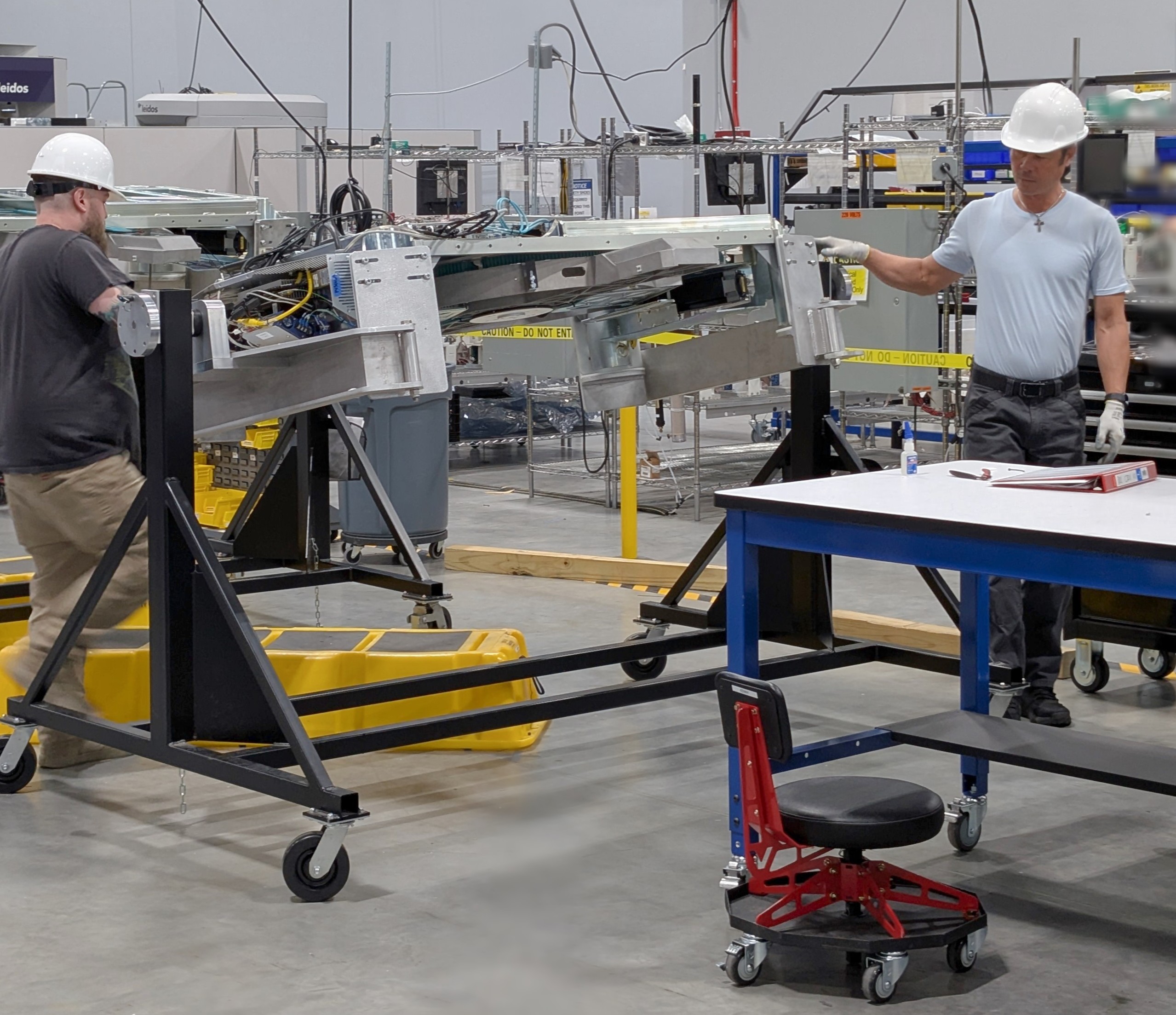
From the start, it was clear this would not be traditional Lean training. Participants were not there to sit through presentations or review case studies. Instead, they went directly to the floor – observing the work, asking questions, mapping the process, and working side by side with the Leidos team to better understand how material and information flowed through the operation.
As one participant reflected,
“It’s one thing to talk about lean principles – but it’s another to stand on the floor, watch the work, and actually make changes.”
Learning by Doing
The event was led by David Woods, President of ProLean Systems and a master Lean Six Sigma practitioner who has worked with manufacturers across South Carolina for decades. Under his guidance, the group divided into teams and focused on different segments of the operation, using core Lean manufacturing tools such as spaghetti diagrams, time studies, and direct observation to build a clearer picture of the current state.
What made this Kaizen event stand out, however, was not just the analysis – it was the action.
Rather than documenting opportunities and moving on, the teams began implementing manufacturing process improvements during the week. Layouts were adjusted, space was opened, and improvements were tested in real time. It created an environment where learning was immediate and practical.
As Woods emphasized throughout the week,
“Ideally, you don’t leave a Kaizen with a list – you take action while you’re there.”
That mindset defined the event. Participants weren’t just learning Lean concepts – they were applying them, seeing the results, and gaining confidence in their ability to improve processes.
The Power of Perspective
One of the defining characteristics of the OpExChange network is the willingness of manufacturers to share openly with peers. That spirit of collaboration was evident throughout this manufacturing Kaizen event.
Participants came from a range of industries and operations, bringing different experiences and perspectives. That diversity quickly became a strength. Fresh eyes helped identify inefficiencies that might otherwise go unnoticed, and conversations between teams created a natural exchange of ideas.
“It’s been wonderful having outside perspective. The mix of non-employees and employees has been refreshing and enlightening.”
Just as important was the openness of the Leidos team. Questions were welcomed, processes were shared transparently, and participants were given the freedom to explore the floor without restriction. That level of trust accelerated the pace of continuous improvement and allowed the group to move quickly from observation to implementation.
Peeling Back the Onion
What began as a focus on layout and manufacturing flow quickly evolved into something more complex.
“This one was like a big onion – we pulled the skin off it and then realized there was another layer underneath.”
As participants dug deeper into the process, they uncovered a series of interconnected challenges. Material movement required excessive handling, with components often moved multiple times before reaching their destination. Large crates introduced inefficiencies, requiring significant effort to unpack and repack while disrupting flow. In some areas, the physical layout – including office space positioned within the production area – interrupted the natural progression of the value stream.
One of the most significant findings centered around testing. As units moved through assembly, they funneled into a shared test process that could take several hours to complete. When issues arose – often tied to factors outside the immediate control of the team – work-in-process began to accumulate. Additional units were started, inventory increased, and available space became constrained.
This created a classic Lean manufacturing challenge: a bottleneck that influenced the entire system. It reinforced an important principle of operational excellence – improving flow requires understanding how each part of the process impacts the whole.
Action – and Its Limits
Throughout the week, the teams made meaningful progress. Space was opened, work areas were reorganized, and practical improvements were implemented immediately.
“Changes were made on the floor immediately – that’s what made this different.”
At the same time, the Kaizen event revealed the limits of what can be accomplished within a short timeframe. Some opportunities required broader changes related to facility layout, power infrastructure, and cross-functional decision-making beyond the production floor.
There was also a shared recognition of how critical timing is in continuous improvement.
“If we don’t implement it now, it may never get implemented.”
This sentiment reflects a common reality in manufacturing. While Kaizen events generate momentum and ideas, sustaining those improvements requires ongoing leadership support and organizational alignment.
People at the Center of Operational Excellence
If there was a consistent theme throughout the week, it was the importance of people.
The individuals closest to the work demonstrated a deep understanding of the process – where inefficiencies existed, where improvements could be made, and how changes would impact daily operations. Many of the most effective ideas came directly from those engaged in the work itself.
The Kaizen created the environment for those ideas to surface.
It also reinforced the role of leadership in enabling Lean manufacturing success. At key moments, the Leidos team provided the support and approval necessary to implement changes during the event. At the same time, it became clear that some of the most impactful improvements would depend on continued leadership involvement after the event concluded.
Operational excellence in manufacturing, as always, lives at the intersection of people, process, and leadership.
Looking Ahead
On the final day, the teams presented their findings and recommendations to Leidos’ senior leadership. The presentation highlighted both the improvements made during the Kaizen event and the opportunities that remain.
But the most important takeaway was not a specific metric or percentage improvement.
“It’s not about the percentage improvement or the numbers – it’s about improving the process.”
For the participants, this was not just a concept – it was an experience. Over four days, they observed, collaborated, and implemented real manufacturing process improvements together.
As they return to their own facilities across South Carolina, they carry more than tools or ideas. They carry a practical understanding of how Lean manufacturing works when applied in real time – and what is possible when people are given the opportunity to step back, evaluate the process, and improve it together.
And in many ways, this is what makes South Carolina’s OpExChange community so unique. There is a willingness to open doors, share challenges, and work side by side in pursuit of something better. Each company, each leader, and each team member has the opportunity to impact not only their own operation, but the broader community around them. When that happens – when knowledge is shared, people are empowered, and improvement becomes collective – the result is something much bigger than any single Kaizen event.
About Leidos
Leidos is a Fortune 500 technology and engineering company headquartered in Reston, Virginia, with approximately 47,000 employees worldwide. The company supports defense, aviation, energy, and critical infrastructure sectors, with a strong focus on security technologies. Its Ladson, South Carolina facility represents a strategic investment in advanced manufacturing, producing security screening systems used in airports, ports, and border crossings around the world. The site integrates engineering, manufacturing, and testing, creating a complex environment where process flow, coordination, and operational excellence are critical. https://www.leidos.com/
About OpExChange
The OpExChange, sponsored by the South Carolina Manufacturing Extension Partnership, is a peer-to-peer network of manufacturers and distributors in South Carolina known for generating success for members through benchmarking and best practice sharing. Member companies host events and share practical examples of industrial automation, lean manufacturing improvements, and leadership development. It is an invaluable resource to South Carolina companies that provide access to others who are on similar improvement journeys. If your company is interested in participating in this collaborative effort to improve both the competitiveness of your operation and South Carolina, contact Mike Demos (MDemos@scmep.org). More information and upcoming plant visits are available on the OpExChange website www.OpExChange.com.
