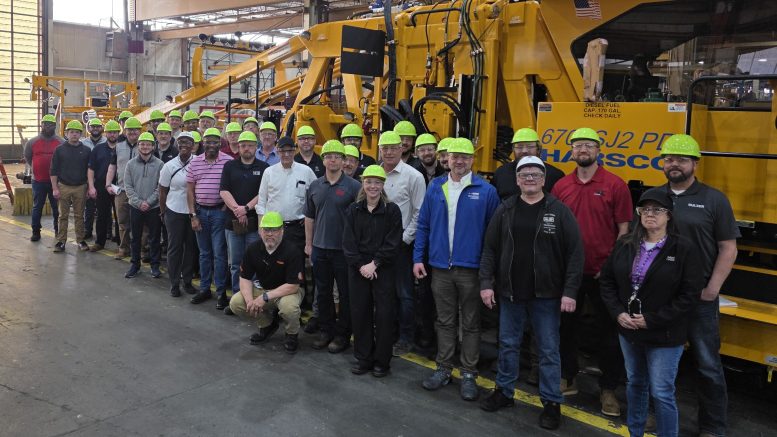
Last week, Harsco Rail welcomed a full house of manufacturing peers from across South Carolina to its West Columbia facility for an OpExChange tour focused on operational transformation.
The visit followed the familiar OpExChange format — presentation, plant tour, and peer collaboration — with Harsco Rail providing a refreshingly honest look at their ongoing transformation.
This was not a polished “look how great we are” presentation. It was a candid look at what it takes to rebuild operational excellence in a complex, low-volume, high-mix manufacturing environment.
And that honesty resonated.
Safety as a Foundation
The day opened with EHS and safety performance. While the business is in the midst of transformation, safety is clearly not an afterthought.
The site has achieved 500+ days without a lost-time accident and maintains a 0.45 recordable rate, which leadership described as industry-leading. They are implementing Job Safety Analysis (JSA) at each workstation and operate an active, workforce-led safety committee that invites managers and supervisors to participate.
In a 224,000-square-foot facility assembling some of the largest machines in the rail industry, that level of safety performance doesn’t happen by accident.
It happens through discipline.
Lean as a Strategic Choice
Mike Lafferty, VP of Operations, spoke candidly about the company’s direction. His message was clear:
“Lean is not a side project – it is our path to operational excellence.”
To accelerate that effort, he brought in Todd McKinley as Director of Continuous Improvement. Todd’s first move was not to launch projects – it was to slow things down.
“We are going to slow down to go faster.”
Instead of chasing dozens of improvement ideas, the team stepped back and applied Hoshin Kanri policy deployment to determine what truly matters. They identified the key KPIs that would drive the business forward and aligned projects accordingly.
Some initiatives were stopped. Others were refined. Every project now must:
- Connect to a key KPI
- Have a clear problem statement
- Include a quantified objective
- Demonstrate accountability and closure
If it doesn’t contribute to business success, it doesn’t move forward.
That discipline required hard conversations – and leadership resolve.
Managing for Daily Improvement (MDI)
One of the most visible changes across the facility is the implementation of MDI – Managing for Daily Improvement.
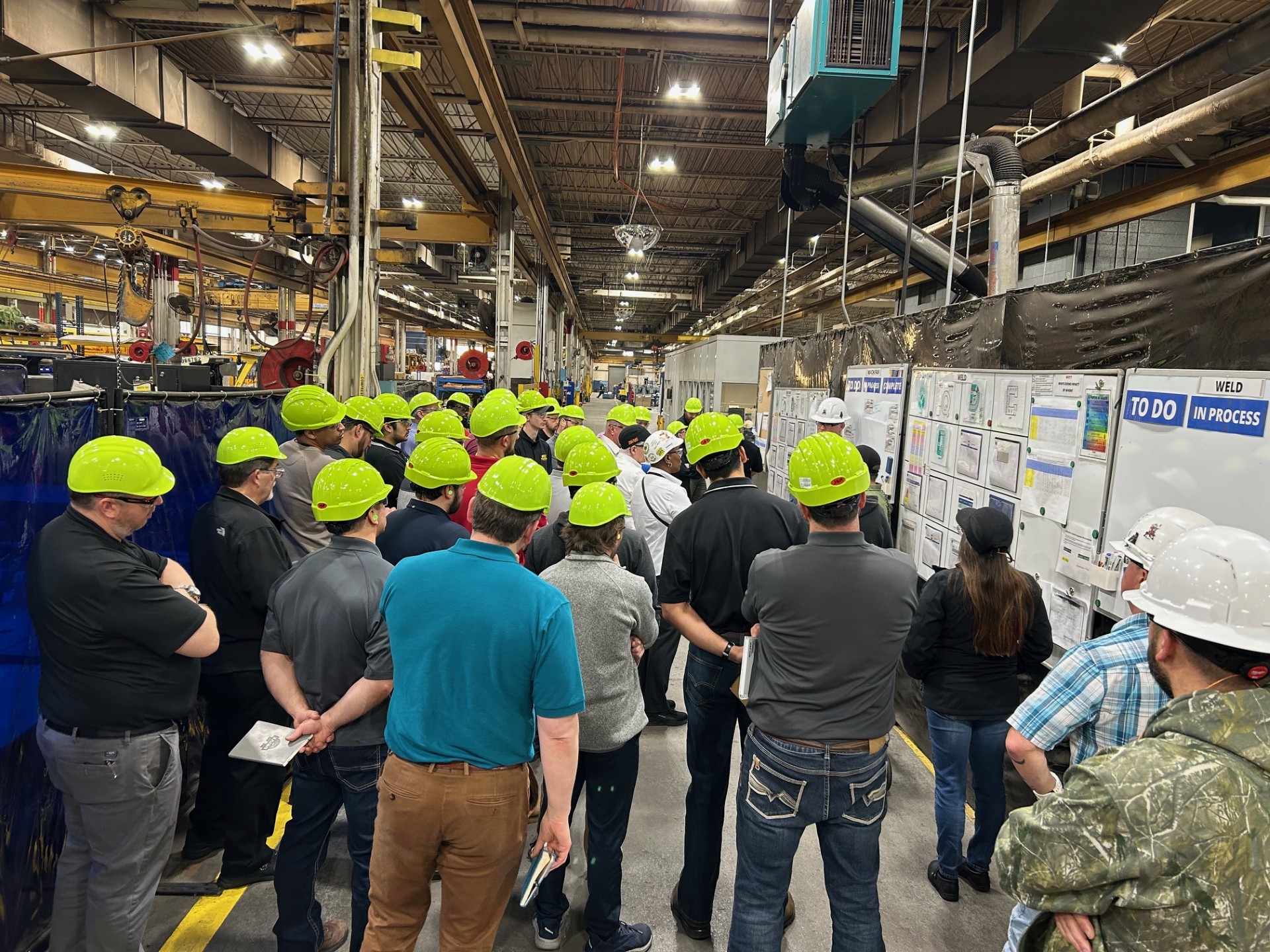
Instead of “Gemba walks,” leadership conducts structured MDI walks. Standardized boards across departments highlight:
- Why do we have the problem?
- Who owns it?
- When will it be resolved?
The boards have evolved through multiple iterations – what Todd described as “generation 12.” That evolution tells its own story: continuous refinement.
One of the loudest signals that emerged from these walks?
Material availability.
Todd stated, “It is difficult to talk about takt time or flow when parts are not at the line.”
The past year has focused heavily on unraveling material flow challenges – and progress is evident.
Material Flow: From Friction to Function
At the front of the plant, the materials team walked visitors through a major transformation.
Previously, inventory accuracy struggled in the low 60% range. The ERP system was not effectively driving material picks. Material shortages rippled throughout the plant.
Today:
- Picks are system driven.
- Inventory accuracy is in the upper 90%.
- Daily synchronization meetings ensure alignment between systems.
- Five vertical storage units from Kardex support organized storage.
- Vendor Managed Inventory partnerships (including Fastenal) are expanding.
- VMI footprint has grown to 2,800 parts, with a goal of 10,000 line-side managed items.
The results are tangible. Material flow is occurring more predictably. Shortages are decreasing. Accountability has increased.
And in a business where each finished machine can contain 20,000 unique part numbers, that matters.
Aftermarket: Precision in Complexity
Harsco Rail’s aftermarket kitting operation is a critical component of the business.
Major customers such as Union Pacific Railroad rely on Harsco Rail to assemble comprehensive rebuild kits – often effectively reconstituting entire machines.
The team averages one large kit per month. These large kits represent the majority of aftermarket activity, supported by a smaller pick-and-ship operation.
Their MDI board in this area highlights SQDC metrics and visually tracks the five most critical parts using card systems similar to Kanban.
Fabrication and Welding: Reset and Refocus
In Machine Fab and Welding, the team faced significant schedule pressure in 2024. Rather than push through inefficiency, they made difficult but necessary decisions — including outsourcing work to stabilize delivery.
During that reset, they 5S’d work areas, improved layout and flow, and launched a scrap reduction initiative.
The results:
- 25% scrap reduction
- First-piece inspections implemented
- “Buddy” sign-off process introduced
- Setup and training gaps identified and addressed
The team is now bringing more work back in-house with improved efficiency.
Visualizing Work and Building Culture
In Sub mechanical and Sub electrical assembly, the changes are visible the moment you step into the area. Layout adjustments and clearer visual management have brought order to what was once harder to interpret. Work-in-process is no longer hidden in corners or buried in complexity. It’s visible. Intentional.
One supervisor summed it up simply:
“You can now see what’s in front of you and what you’re going to be working on next.”
That clarity matters.
Further down the line in Final Assembly, the challenge shifts. These machines are massive. Some are engineered-to-order builds that can take up to 24 months to complete. When your product cycle spans two years, the question becomes more nuanced:
“What does a successful day look like?”
It’s a different kind of Lean thinking – less about hourly takt and more about disciplined progress, measurable milestones, and sustained momentum over time.
The cultural evolution is still underway. Team leads are actively engaged in MDI, and broader workforce adoption continues to grow. The foundation is being laid deliberately.
Transformation at this scale doesn’t happen overnight. It builds, layer by layer – visible in layout changes, daily boards, and the steady shift in how success is defined.
Investing in People
During the collaboration session, one peer asked a practical question: How do you attract and secure strong technical talent in today’s environment?
Harsco Rail’s approach begins with rigor on the front end. For skilled positions, they utilize structured screening methods to ensure capability before hiring:
- CNC candidates complete simulator-based testing, including program correction and program writing.
- Welders perform hands-on weld tests to demonstrate skill proficiency.
- New hires begin through a contract-to-hire process with a formal 90-day evaluation period.
Once onboard, the focus shifts from screening to development and engagement:
- A structured train-the-trainer program helps build internal capability and knowledge transfer.
- An active, workforce-led safety committee reinforces shared ownership of workplace safety.
These efforts reflect more than hiring practices or training programs – they represent a deliberate investment in building skill, accountability, and long-term capability across the organization.
The Power of Openness
Perhaps the most powerful part of the visit was Harsco Rail’s openness.
They did not present a finished product.
They presented a business in transformation, with a vision.
They shared their challenges, their experiments, their resets, and their progress. They invited peers into the conversation. During collaboration, participants offered ideas — including learning opportunities from other manufacturers that have solved similar material flow challenges.
That is the spirit of OpExChange.
Manufacturers opening their doors.
Learning from one another.
Raising the bar together.
Harsco Rail’s journey is still underway. But the direction is clear: disciplined Lean deployment, material flow stabilization, visible accountability, and a renewed focus on operational excellence.
And in a facility building some of the largest, most complex rail machines in the world, that commitment is no small undertaking.
About Harsco Rail
Harsco Rail is a global supplier of railway track maintenance and construction equipment, supporting more than 125 railway customers worldwide. Operating as a segment of Enviri Corporation (formerly Harsco Corporation), the company designs and manufactures tampers, grinders, tie-handling equipment, HY-RAIL® vehicles, and engineered-to-order specialty machines. In addition to equipment manufacturing, Harsco Rail provides aftermarket parts, kitting services, and contracted field services to help rail operators maintain safe and reliable infrastructure. Its major U.S. operations include headquarters in Charlotte, North Carolina, and a 224,000-square-foot manufacturing facility in West Columbia, South Carolina. https://harscorail.com/
About OpExChange
The OpExChange, sponsored by the South Carolina Manufacturing Extension Partnership, is a peer-to-peer network of manufacturers and distributors in South Carolina known for generating success for members through benchmarking and best practice sharing. Member companies host events and share practical examples of industrial automation, lean manufacturing improvements, and leadership development. It is an invaluable resource to South Carolina companies that provide access to others who are on similar improvement journeys. If your company is interested in participating in this collaborative effort to improve both the competitiveness of your operation and South Carolina, contact Mike Demos (MDemos@scmep.org). More information and upcoming plant visits are available on the OpExChange website www.OpExChange.com.
Be the first to comment on "Harsco Rail: Lean as a Path Forward"