
Focus, Simplicity, and Operational Discipline
In manufacturing, complexity often creeps in quietly. More product variants. More options. More engineering changes. More processes layered on top of processes. Left unchecked, that complexity can slow an organization down.
At ITW Hartness, the philosophy is different. Focus on the critical few. Simplify the rest.
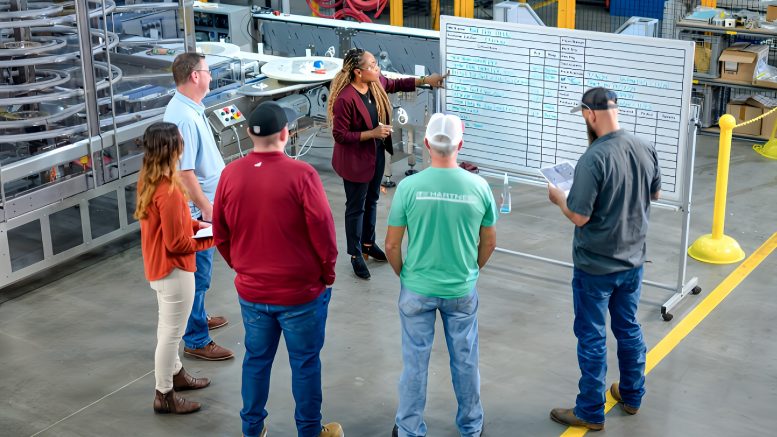
On March 3rd, OpExChange members gathered in Greenville, South Carolina for a plant visit focused on the 80/20 program at ITW Hartness. During the visit, participants toured the ITW Hartness Greenville manufacturing facility, gaining an inside look at how the company designs and builds advanced packaging automation equipment. The event explored how the company applies the ITW operating model to drive operational clarity, manufacturing efficiency, and continuous improvement.
The visit followed the familiar OpExChange format – presentation, plant tour, and peer collaboration – but the theme running throughout the day was unmistakable: Operational excellence through focus.
ITW Hartness: A Greenville Manufacturing Legacy
The Hartness story begins in 1940 when Tom Hartness acquired the Pepsi-Cola bottling franchise in Greenville. Frustrated with the inefficiencies of manual case packing, he engineered a mechanical solution – the first Hartness case packer – launching a business that would eventually become a global leader in packaging automation.
Today, ITW Hartness operates from a 256,000-square-foot global headquarters in Greenville, employing roughly 350 people and serving customers across beverage, food, and personal care markets worldwide.
Their core technologies include:
- Case packing systems
- Accumulation systems
- Hi-Cone carrier applicators
- Packaging automation equipment
As Director of Operations Mark Hostetler explained to the group, if you walk down the beverage aisle of almost any grocery store, there’s a good chance the product passed through a Hartness machine somewhere along the way.
But the real story of the visit wasn’t just the equipment. It was how the organization operates.
The ITW 80/20 Manufacturing Philosophy
In 2009, Hartness became part of Illinois Tool Works, a Fortune 200 industrial manufacturer known for its disciplined operating model. At the center of that model is the 80/20 principle, derived from the Pareto Principle, which observes that a small percentage of inputs often drives the majority of results.
In business terms, this frequently appears as:
- 20% of customers generating 80% of revenue
- 20% of products generating 80% of profit
- 20% of problems creating 80% of defects
At ITW, the concept becomes an operating discipline.
Rather than trying to optimize every activity equally, the organization identifies the “critical few” drivers of performance and focuses its resources there.
As Hostetler explained during the presentation, the ITW model brought a new level of operational discipline after the company joined the organization.
“We went from being a good company to a great company,” he told the group, describing the impact of the ITW operating system.
To implement that philosophy, the company uses a set of improvement tools often referred to internally as the ITW Toolbox, including:
- Product Line Simplification (PLS) – streamlining the product offering
- Understand, Simplify, Automate (USA) – improving processes through observation and simplification
- Inlining – building equipment in sequential assembly flow
- Market Rate of Demand (MRD) – aligning production and inventory with real demand
- Market Segment Focus (MSF) – concentrating on the most valuable customers and markets
The goal is straightforward: remove complexity so teams can focus on what matters most. Embedded within this program are several lean manufacturing principles and methodologies.
Inside ITW Hartness Manufacturing and Packaging Automation
One of the most interesting aspects of the tour was how visibly the 80/20 philosophy appeared throughout the facility. During the walkthrough, tour leaders pointed out specific production areas organized around the company’s “80” and “20” production areas.
The “80” lines represent the high-volume products and configurations that make up the majority of the company’s business, while the “20” lines handle lower-volume or more specialized builds.
By separating and managing these differently, the organization can maintain efficiency and flow on its core production lines while still supporting custom or lower-volume work.
It was a simple but powerful illustration of the ITW philosophy translated into real manufacturing practice.

Assembly Operations at ITW Hartness Greenville
Much of the tour focused on the assembly areas, where several major product lines are built and tested before shipment to customers around the world.
Case Packing
On the case packing line, machines gently place bottles into cases using inflatable airbag systems that prevent damage to labels and packaging.
This “soft touch” approach is particularly important for premium beverage products where packaging appearance matters.
These machines can operate at speeds exceeding 70 cases per minute.
Wraparound Case Systems
Another line demonstrated high-speed wraparound packaging equipment that forms cases around products using flat cardboard blanks.
The machines fold and glue the packaging around the product in a continuous motion process.
Modular assembly techniques allow portions of the machine to be built separately and integrated later, reducing build time and simplifying manufacturing flow.
Hi-Cone Carrier Systems
Participants also observed the assembly of the Hi-Cone Gen 2 carrier applicator, capable of applying beverage carriers at speeds exceeding 1,200 bottles per minute.
High-speed vision systems orient bottles so labels and UPC codes face the correct direction for retail scanning.
Accumulation Systems
Perhaps the most distinctive Hartness innovation is its DYNAC accumulation system, which buffers product between machines on high-speed production lines.
“If you shut a filler down, it’s a big deal,” Hostetler explained during the presentation. “Our accumulator allows the line to keep running.”
These systems temporarily store product while downstream equipment is serviced or restarted, preventing costly production interruptions.
Fabrication
In addition to assembly, the group toured the fabrication areas, where many of the machine components are produced before moving to final assembly.
These operations showcased impressive levels of automation and precision fabrication, including advanced equipment used to cut, form, and prepare metal components that make up the company’s packaging systems. The fabrication areas reflected the same 80/20 operating philosophy seen throughout the facility. Equipment layout, production flow, and work organization were aligned around the company’s core “80” items – the components that represent the majority of demand – while lower-volume “20” items are handled in ways that minimize disruption to the primary flow.
The result is a manufacturing environment that balances automation, operational focus, and flexibility, enabling the Greenville facility to efficiently produce complex capital equipment for customers around the world.
Continuous Improvement in the Details
While the equipment itself was impressive, many of the most interesting observations came from the operational details across the facility. Assembly carts and tooling are designed so technicians can perform tasks within one or two steps, minimizing motion and improving efficiency.
Visual management boards track key metrics for each department, including safety, quality, performance, and continuous improvement activities. Team leaders update these boards manually, reinforcing ownership and daily engagement with performance metrics. One participant commented that it was impressive that business functions such as purchasing and customer service also maintain KPI boards on the shop floor, reinforcing visibility and alignment across the organization.
Even small fixtures and gauges have been standardized to remove variation from assembly processes. As Assembly Supervisor Andy Fowler explained during the tour:
“When you do an 80/20 or USA project, it doesn’t have to be complicated… it’s not always a home run or a hundred-thousand-dollar saving, but it creates consistency and standardization.”
Collectively, these types of improvements reinforce the disciplined execution that defines the operation.
Observations from the Peer Group
Following the tour, participants gathered for the traditional Plus/Delta collaboration session, where peers share observations and improvement ideas.
One participant captured a common reaction:
“It seems like everybody’s aligned from the 80/20. Getting everybody in a row like that is an effort.”
Other positives noted by the group included:
- Exceptional organization and cleanliness across the facility
- Strong visual management practices
- Active safety engagement programs
- Clear operational metrics displayed throughout the plant
Participants also offered suggestions that ITW Hartness might consider for further improvement – reinforcing the collaborative learning environment that defines OpExChange events.
Investing in the Next Generation
The group also learned about the company’s Tech Scholar Program, which partners with local high schools to help students pursue technical careers.
Students work at the facility while attending vocational training programs and often transition into full-time roles after completing their education.
“We partner with local high schools,” Hostetler explained. “They work here while they’re in school, and hopefully when they finish we’ve done a good enough job that they want to come work for us.”
It’s a practical example of how manufacturers are addressing the skilled workforce pipeline.
The Power of Focus
Manufacturing organizations often chase improvement through new technologies. At ITW Hartness, the lesson from the day was something simpler – Focus!
By identifying the critical few priorities – the customers, products, and processes that truly matter – the organization removes unnecessary complexity and enables teams to execute with clarity.
In other words, Operational excellence doesn’t always come from doing more. Sometimes it comes from doing fewer things – extremely well.
About ITW Hartness
ITW Hartness, headquartered in Greenville, South Carolina, is a division of Illinois Tool Works and a global leader in secondary packaging automation. The company designs and manufactures equipment including accumulation systems, case packers, and beverage carrier applicators used by food, beverage, and consumer goods manufacturers worldwide. With more than 80 years of engineering innovation, Hartness equipment helps production lines improve efficiency while reducing downtime.
About OpExChange
The OpExChange, sponsored by the South Carolina Manufacturing Extension Partnership, is a peer-to-peer network of manufacturers and distributors in South Carolina known for generating success for members through benchmarking and best practice sharing. Member companies host events and share practical examples of industrial automation, lean manufacturing improvements, and leadership development. It is an invaluable resource to South Carolina companies that provide access to others who are on similar improvement journeys. If your company is interested in participating in this collaborative effort to improve both the competitiveness of your operation and South Carolina, contact Mike Demos (MDemos@scmep.org). More information and upcoming plant visits are available on the OpExChange website www.OpExChange.com.
Be the first to comment on "ITW Hartness Greenville: 80/20 in Action at a Global Packaging Automation Leader"