
By Andre Harris, Vice President, A M King
Join us for this three-part series about manufacturing equipment installation. In Part 1, we explore the challenges. Part 2 will cover why preparation is so important, and in Part 3 I’ll reveal how we seamlessly integrate new machines into industrial facilities.
Several years ago, GE Gas Turbine (now GE Vernova) embarked on a mission to bring four custom-built, 10-ton grinding machines to its Greenville, SC campus. The goal was to increase not only grinding capacity, but also the precision with which they could shape parts for gas turbines. As the company’s long-time Design-Build partner, A M King was commissioned to perform this manufacturing equipment installation.
Because return-on-investment (ROI) and speed to market are so critical in this industry, this complex project required extensive preparation to ensure a successful outcome. In fact, 75 percent of the work we did occurred before the equipment ever arrived on site.
Historically, the focus with manufacturing equipment installation is on the last phase when the machine(s) are actually delivered. While we can seamlessly execute that function, we find that the entire process is more efficient if we concentrate on the preceding three-quarters of the project.
Because A M King already provides GE with ongoing facility services, we are in the best position to manage the complex installation of their equipment. We have become familiar not only with the equipment, but also with utilities, existing conditions, access routes, etc.
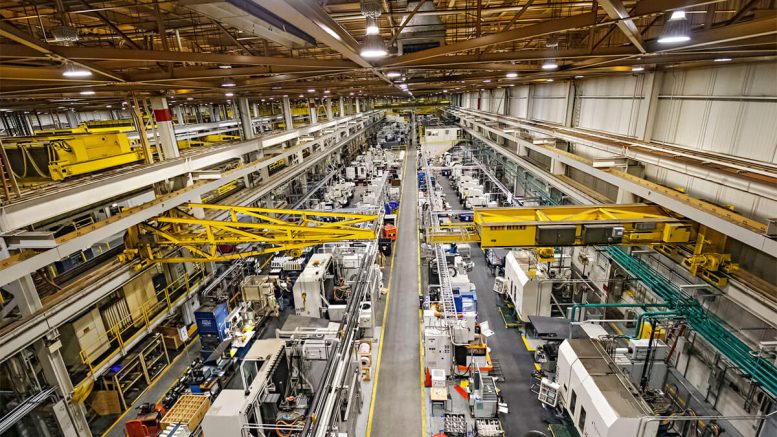
In today’s manufacturing environment, equipment often includes a variety of multifaceted, technical components and electronics — which in turn, highly automates functions and processes. Furthermore, much of this equipment is large, with heights and lengths measuring in many feet, and weights measured in tons.
This type of manufacturing equipment must also be custom designed and fabricated, takes months to build, and requires specific expertise for commissioning and start-up. Manufacturers purchase their new equipment as an investment, with a specific ROI duration.
An efficient installation is necessary to ensure the equipment operates correctly, supporting the manufacturer’s overall facility production goals.
In addition to GE, A M King provides ongoing facility services to other manufacturing clients such as ZF Transmissions Gray Court; and Honeywell Aerospace. We routinely collaborate with these companies about potential upgrades and timelines for achieving their facility goals. If new equipment is needed, we assess whether demolition or modifications are required and wisely use the time that the machine is being fabricated to prepare space for it.
Stay tuned for Part 2 of this three-part series, where we’ll cover why preparation is so important for successful manufacturing equipment installation. In the meantime, follow A M King on LinkedIn or check out our website at amkinggroup.com.
Be the first to comment on "The Keys to Successful Manufacturing Equipment Installation (Part 1)"