
By Andre Harris, Vice President, A M King
Thanks for reading our three-part series about manufacturing equipment installation. In Part 1 we talked about common challenges and introduced a client story. This time we’re exploring why preparation is so important, and in the final installment we’ll focus on the results.
When GE made the decision to purchase custom-built, 10-ton grinding machines, we entered discussions with them about how to integrate the first of four machines into their existing facility. The earliest part of this phase included three important actions we needed to take:
- Gather information about the machines, which we did during our trip to GE’s manufacturing plant in northern Spain.
- Develop an as-built model of the machines — much like we do as-built drawings of a building — so that we would have dimensions such as height and weight.
- Identify utility requirements.
Having this information would eliminate last-minute modifications and delays in completion, or changes once the equipment arrived in Greenville, SC. From this point, the machines would take two years to build.
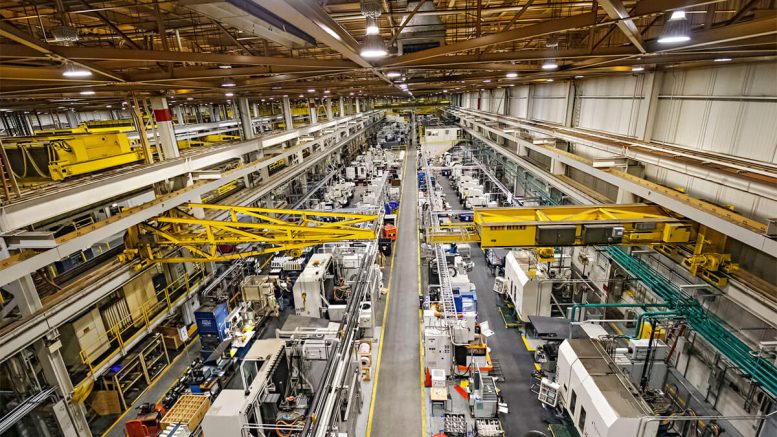
Because A M King is an integrated Design-Build firm, many of our projects begin with property consulting and our manufacturing projects are no different. While GE’s machines were being made, we focused on identifying spaces within their 1.5 million-sf facility that could house the new equipment and conducted impact studies to determine the best location for desired cost, schedule and logistics outcomes.
Our planning process involved plant engineers, equipment operators, equipment suppliers, and of course our team of associated subcontractors and vendors. During this time, we focused on preparing foundations, utilities and overhead clearance in the selected space, and worked with the client to determine how they would make use of the new capacity.
Our tenure at GE — and it’s also happening at Honeywell and ZF — creates an advantage for both the client and A M King. The information transfer is happening organically. The more projects we do, the more knowledge we gain and the more value we can bring.
A M King has been working at GE Greenville for 20 years and in that time, we’ve touched a lot of equipment. On the grinding machine install project, we removed a machine that we previously installed to make room for the new grinding machines. Because we put the original equipment in, we knew how much concrete had to be removed, and how to handle electrical and utilities. That is knowledge that we wouldn’t have had otherwise.
At Honeywell Aerospace in Greer, SC — another facility services client — we led a phased expansion to support the complex infrastructure requirements of four new EV-PVD coater machines. To prepare for the arrival of the new equipment, we constructed 20,000 square feet of new manufacturing space on the west edge of the existing facility and upgraded all required utilities.
The Design-Build project for Honeywell also encompassed renovation of the existing 180,000-square-foot facility, including 20’ higher ceilings to accommodate the new machines; design and construction of an operations room; a mechanical room; and an electrical room powering the current coater with capacity for three additional coaters. One unique component of this project was our installation of a process water cooling system, which was designed especially for the sensitive coating equipment.
If you missed Part 1 of this series, click here, and don’t miss our Part 3 finale, coming soon. If you want to learn more about A M King, follow us on LinkedIn or check out our website at amkinggroup.com.
Be the first to comment on "The Keys to Successful Manufacturing Equipment Installation (Part 2)"