
By Mike Demos, OpExChange Coordinator for the SCMEP
The anticipation was palpable on August 19 as members of OpExChange gathered for a highly coveted tour of BMW Manufacturing’s Spartanburg facility. Promoted since January, the event filled its 45 available spots in just five minutes, leaving a growing waiting list of manufacturers eager to learn from one of the world’s leading automotive operations.
This marked BMW’s second hosted OpExChange event, the first having focused on their Body Shop and Lean Six Sigma practices. This time, the spotlight was on Hall 52, one of BMW’s automated assembly halls, where innovation, precision, and digital technology converge on every vehicle.
Brad Stone, BMW’s VPS Operational Leader and Lean Six Sigma Master Black Belt, orchestrated the tour. With nearly three decades of experience at BMW, Stone coordinated the event alongside the plant’s Innovation team, including John Mitchell, Structural Digital Specialist and NVIDIA Omniverse Ambassador, and Austin Evans, a BMW Data Scientist. Both offered deep dives into BMW’s application of digital twins, AI, and data-driven manufacturing, leaving attendees inspired by the plant’s sophisticated operations.
Touring Hall 52: Assembly in Action
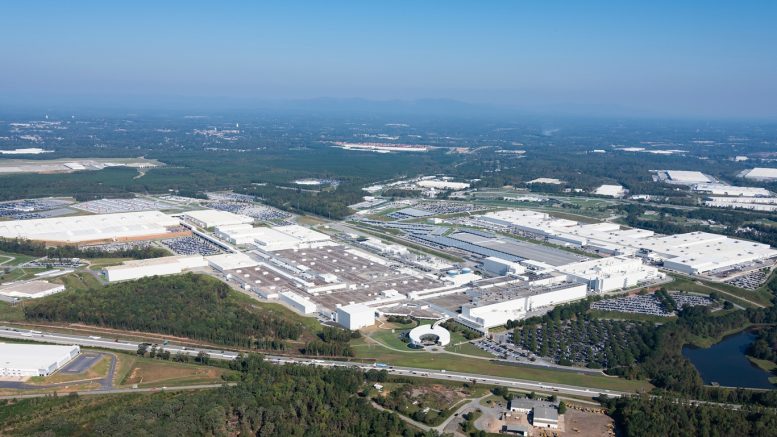
The tour began in the BMW Zentrum, with attendees traveling a short distance to Assembly Hall 52, also known as Assembly North. Here, BMW assembles the X3 and X4 mid-size Sports Activity Vehicles, while Assembly South (Hall 50) handles the larger X5, X6, X7, and XM models. Together, the halls produce approximately 1,500 vehicles per day, with total output in 2024 exceeding 396,000 units.
The rationale behind BMW’s South Carolina location became clear during the tour: a robust rail system, a skilled local workforce supported by technical colleges, proximity to Greenville-Spartanburg International Airport, and access to the port of Charleston for global exports. Even the solar panels visible from Interstate 85, which fully power the 24,000-square-foot BMW Zentrum, underline the plant’s commitment to sustainability.
Inside Hall 52, visitors witnessed the choreography of advanced manufacturing. Vehicles arrive with their bodies already painted, and doors are removed and routed to a dedicated subassembly line before being reattached. Each vehicle carries a “black box” transponder that tracks its build data, from engine type to paint color, enabling both Just-in-Time (JIT) and Just-in-Sequence (JIS) operations. This level of precision ensures that parts are delivered in the exact order they are needed, supporting customization without disrupting the flow of the line.
Ergonomics and operator safety were apparent at every stage. Vehicles move along C-shaped carriers that tilt and lift to optimize access for assembly associates. Later, wooden pallets provide full access around the vehicle. Associates rotate through multiple jobs per shift, promoting skill development and reducing physical strain. KUKA robots support the workforce, including the application of glass and adhesive, using “Best Fit Technology” to adjust in real time for tiny variances in vehicle geometry. Some associates rely on Raku chairs for easy access inside the car, a subtle but important detail in the plant’s commitment to human-centered design.
Sustainability and Operational Excellence
BMW Spartanburg has long been a leader in sustainable manufacturing. Hydrogen-powered forklifts traverse the halls, providing emission-free mobility, while methane captured from the nearby Palmetto Landfill supplies about 20% of the plant’s energy needs. Solar panels power the Zentrum and vehicle recharging stations, and extensive recycling operations manage steel, cardboard, and glass.
The plant’s scale and scope are remarkable. Over 4,000 associates directly participate in vehicle assembly, installing more than 8,000 parts per car, from engines sourced from BMW factories in Hams Hall, England, or Steyr, Austria, to complex wiring harnesses provided by Draexlmaier. BMW’s meticulous quality control processes include fluid fill, battery pack installation for plug-in hybrids, and multi-stage inspections that ensure vehicles meet the brand’s high standards.
With a world-class workforce, advanced robotics, and sophisticated digital integration, BMW Spartanburg maintains an impressively low turnover rate of just 3%, including contract associates. The plant exports more than half its vehicles to 120 markets worldwide, reflecting a global footprint supported by an efficient rail system and proximity to the port of Charleston. Since 1992, BMW has invested over $14.8 billion in the facility, now employing more than 11,000 people across eight million square feet, and undergoing its seventh major expansion.
Innovation in Digital Manufacturing
BMW is in the midst of a transformation that goes far beyond the assembly line. The company is embedding digital tools, simulations, and AI-driven processes across its operations. Two areas in particular – the Digital Twin utilizing NVIDIA Omniverse and the company’s broader AI Strategy led by GAIA – stood out as defining moments of the visit.
The Digital Twin: Redefining Operations
Of all the concepts presented, none sparked more excitement and questions than BMW’s implementation of the Digital Twin, supported by NVIDIA’s Omniverse platform. Visitors were captivated by its potential to fundamentally reshape how plants are designed, optimized, and operated. BMW’s roadmap for the twin consists of five phases:
- Layout Twin – virtual layouts of the facility.
- Process Twin – modeling how each process fits into production.
- Simulation Twin – running predictive scenarios for performance, throughput, and quality.
- Operational Twin – mirroring real-time plant data to the virtual model.
- AI-Defined Factory – a fully autonomous operation where AI agents plan and execute production.
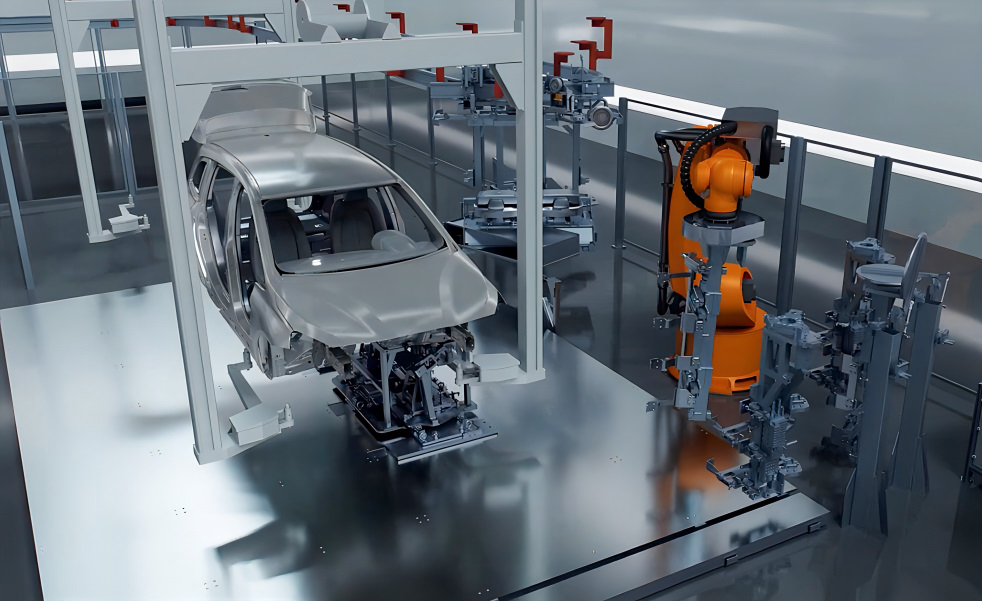
Image from BMW Digital Twin using NVIDIA Omniverse
When asked which stage BMW had reached, John explained that they are currently between stages 2 and 3, though in truth, their teams have their “hands in all stages.” He shared a candid lesson: just six months into phase 1, BMW realized they needed to redefine some of their foundational work to ensure the twin would be useful across the entire enterprise. That reevaluation has paid off.
Even at this early point, BMW has already seen significant operational gains from the twin – reducing downtime, optimizing workflows, and enabling data-driven decisions with new levels of speed and accuracy.
Perhaps the most thought-provoking exchange of the day came when a visitor asked John what stage 5 – the AI-defined factory – might look like. His answer: “Orders will come in, and the system will automatically plan how they’re built in the shop.” For many attendees, that vision transformed abstract buzzwords into a tangible glimpse of the future of manufacturing.
BMW’s AI Strategy and GAIA: Beyond the Twin
While the Digital Twin is groundbreaking, it is just one piece of BMW’s larger AI strategy. Austin emphasized this point, noting that the company views AI not as a side project but as a central driver of its manufacturing future. A highlight of this strategy is GAIA, BMW’s Group Artificial Intelligence Assistant.
Already in use by more than 1,000 employees in Spartanburg, GAIA acts as a secure self-service platform for interacting with generative AI. The system includes:
- An expanding app store with custom bots developed by employees across BMW, enriched with company-specific data.
- No-code app creation tools in its “dev space,” allowing associates to build and share their own tools.
- Built-in training resources to help users improve prompting skills and AI literacy.
- A data interpreter app that can analyze Excel or CSV files via natural language queries, producing analysis code, graphs, and tables that can be dropped directly into presentations.
Austin demonstrated GAIA with a sample dataset of vehicle master data, showing how simple prompts could generate targeted analysis – for example, drilling into details of the B58, the turbocharged 3.0L BMW engine. Attendees were impressed by the immediacy and practicality of the tool, particularly as it outputs not just results but also the underlying code and visuals for validation and reuse.
The broader takeaway was clear: BMW is embedding AI deeply into its culture. By making tools like GAIA available to a wide workforce, the company is not just experimenting – it is accelerating AI adoption at scale.
Closing Reflection
The visit to BMW Spartanburg offered OpExChange members far more than a glimpse into world-class automotive assembly – it was a clear vision of manufacturing’s future. From renewable energy sourced from landfill gas to hydrogen-powered forklifts, from the precision of Just-in-Sequence delivery to the jaw-dropping realism of the Digital Twin, BMW demonstrated how technology, sustainability, and people can come together in harmony.
What resonated most was that these tools are scalable. BMW’s resources may be vast, but their approach – experimenting, learning, adapting, and scaling – is one that any manufacturer can follow. As Austin Evans reminded the group, AI is not just for large manufacturers; even smaller plants can harness its power to solve problems faster and make better decisions.
Ultimately, the lesson was clear: BMW Spartanburg is not just producing SUVs; it is producing a roadmap for the factories of tomorrow. And for South Carolina manufacturers, the inspiration and ideas carried home from Hall 52 will fuel improvements long after the tour concluded.
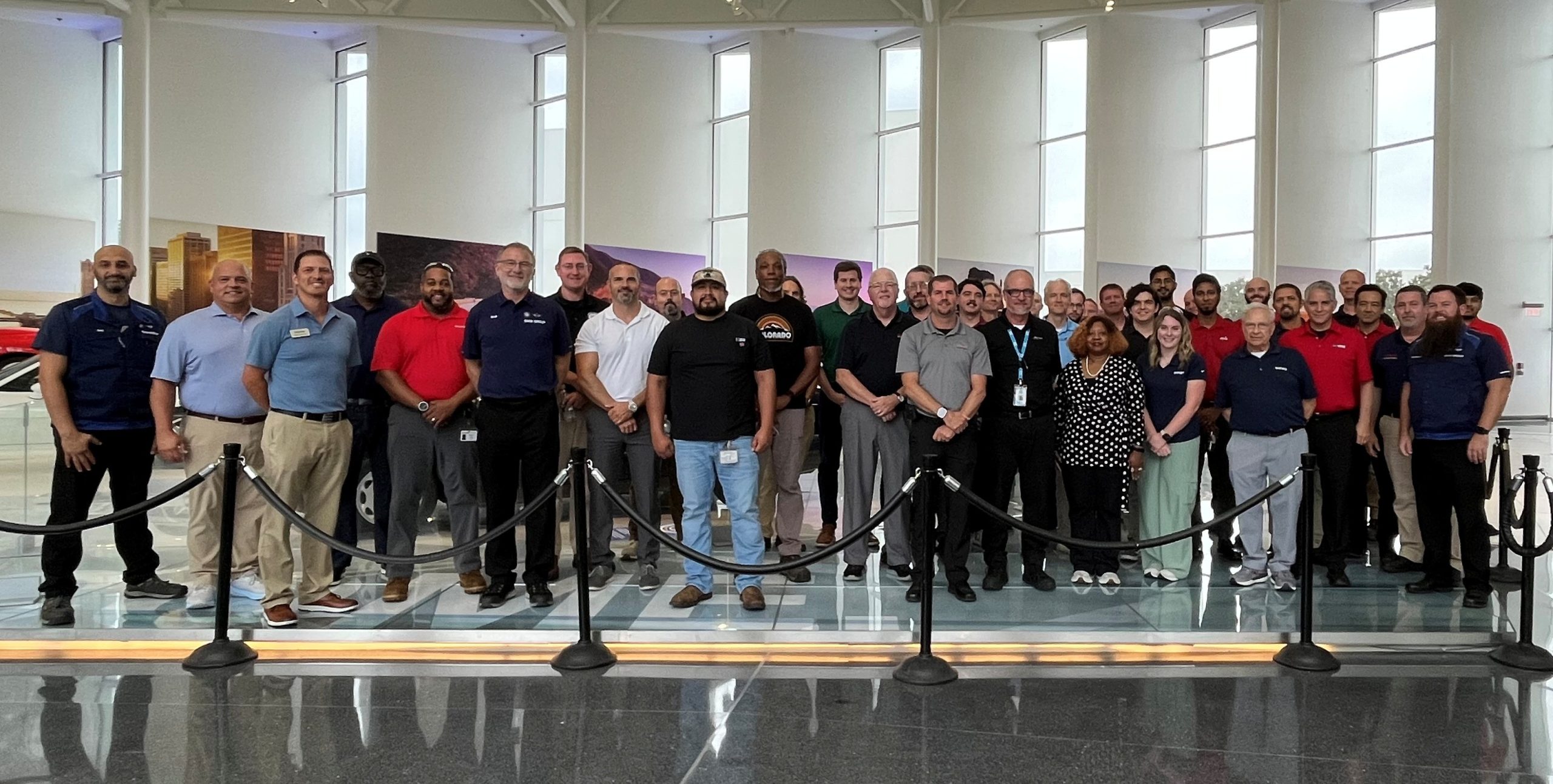
OpExChange August 19, 2025 BMW Visit
About BMW Group Plant Spartanburg
BMW Manufacturing employs 11,000 people at its eight million square-foot campus. The Spartanburg plant assembles the BMW X3, X4, X5, X6, X7, and XM Sports Activity Vehicles and Coupes and their variants. For more than 30 years, its associates have been proud to assemble more than 7 million safe, premium-quality BMWs for customers around the world. According to the U.S. Department of Commerce, the BMW Group is the largest automotive exporter by value from the U.S. with a total export value of about $10.1 Billion in 2024.
About OpExChange
The OpExChange, a program of the South Carolina Manufacturing Extension Partnership (SCMEP), is the only peer-to-peer network of manufacturers and distributors across South Carolina. For over 23 years, this collaborative group has helped member companies improve performance through benchmarking, best practice sharing, and collective learning. Member companies regularly host site visits and events, offering real-world examples of industrial automation, lean manufacturing initiatives, workforce engagement, and leadership development. It is an invaluable resource for South Carolina manufacturers seeking to learn from others on similar operational excellence journeys.
If your company is interested in joining this collaborative effort to strengthen both your operation and South Carolina’s manufacturing community, reach out to Mike Demos at mdemos@scmep.org. Visit www.OpExChange.com for more information on joining and a list of upcoming plant visits.
Be the first to comment on "OpExChange at BMW: Innovation, AI, and the Future of Automotive Assembly"